
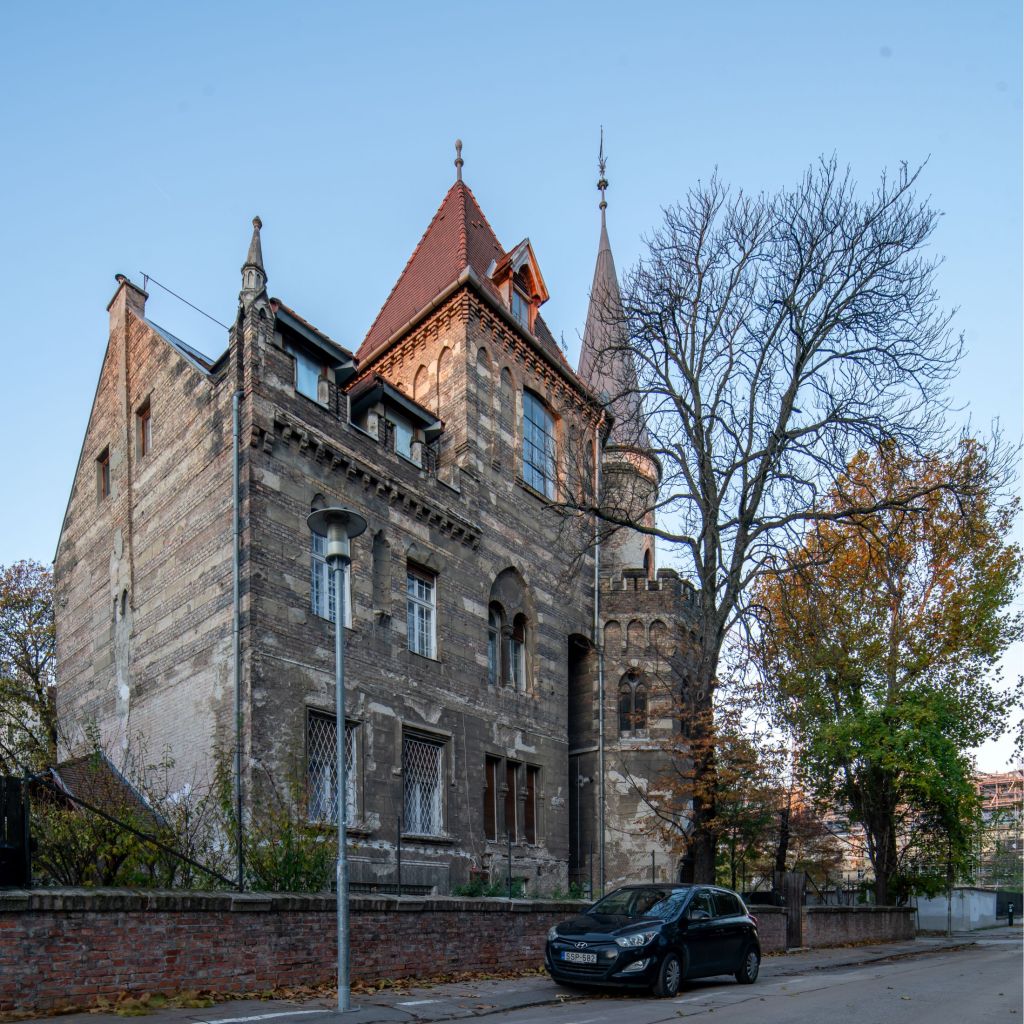
Is this a photo of a romantic little castle somewhere in Ireland? Not at all; this is a villa standing on Zichy Géza utca in Zugló, the 14th district of Budapest. However, it indeed has a direct link with Ireland: it was built for a famous portrait painter, Fülöp László, who wanted to impress the parents of the woman he wanted to marry, Lucy Guinness. She was a member of the Guinness family, the granddaughter of Robert Rundell Guinness, who founded the Guinness Mahon bank. Lucy, a talented violinist, studied music in Munich, where she met Fülöp, who was then a student at the Royal Bavarian Academy of Fine Arts. The plan worked well, and Lucy’s parents gave their blessing to the couple.
Interestingly, the couple did not enjoy the villa designed by László Gyalus for a long time. In 1907, only four years after the house’s completion, the couple moved to London. Following his arrival in the United Kingdom, Fülöp László, now known as Philip de László, quickly garnered attention for his exceptional ability to capture the essence of his subjects. His portraits of English royalty, including the iconic depictions of King George V and Queen Mary, became emblematic of his talent and garnered widespread acclaim. Beyond the royal family, de László’s clientele extended to influential figures in English society, politics, and culture.
Following the couple’s departure, the villa was rented out for a few years before being sold to Ferenc Paupera. The building attracted many artists who enjoyed living here and working in the large ateliers. Ferenc Molnár, a famous author mostly known for his novel “Pál utcai fiúk” (The Paul Street Boys), lived here for two years. Béla Lajta also resided in this building for two years.
After World War 2, an actor called Géza Berczy purchased the villa from its previous owner who had emigrated to Australia. According to the Szabad Nép newspaper (though its trustworthiness is uncertain), Géza installed a shady Chinese-themed bar called the “Ting Tang” in a small house located in the courtyard of the villa. Visitors reportedly arrived at the bar, which operated without a license, late at night. They drank and partied before going to Berczy’s apartment, where, in the most shameless manner, they were robbed of every last fillér (penny). The robbed gentlemen staggered onto the street, banging on doors, hitting gates, shouting, and sometimes resorting to violence. Other sources reported that the Berczys were indeed a source of trouble. In 1948, Szabadság wrote that Géza’s wife got into a conflict with the widow of the engineer Arnold Truszka and ended up throwing an axe at her from the villa, almost hitting her head. In 1949, the communist regime confiscated the villa from the Berczys, but they were allowed to stay in one of the apartments.
If you observe attentively the wall of the villa, you will spot an inscription in Cyrillic. This was left by Soviet soldiers in 1945 after they cleared the building of explosives. You can find photos and information about this type of inscription here.



 Buildings Tell Tales
Leave a comment